
Enough.

Years ago I worked for Joe.
Joe possessed the rare combination of being exceptionally talented and exceptionally stoned with such consistency that whether the two were related seemed beside the point. They were simply facts about him, the way one might say someone has blue eyes or an unfortunate mustache.
He wandered over.
He looked down at the desk I'd built for the studio. The desk was, in the way of objects made by young men who have recently discovered that they can make things substantial, extremely substantial.
Joe stood there longer than the moment seemed to require. He leaned on the top.
“If there was ever an earthquake,” he said, “I'd crawl underneath your desk.”
Everybody laughed. So did I.
The compliment made perfect sense because it confirmed something I already believed. Durability was virtuous. Stronger was better. If a thing could survive a seismic event, that seemed not excessive but responsible.
But after a while the compliment began to nag. I hadn’t selected a ridiculous material or, in some fever of structural anxiety, bolted the thing to bedrock. Every choice had been defensible.
So how had I ended up with a bunker instead of a desk?
I never really answered the question.
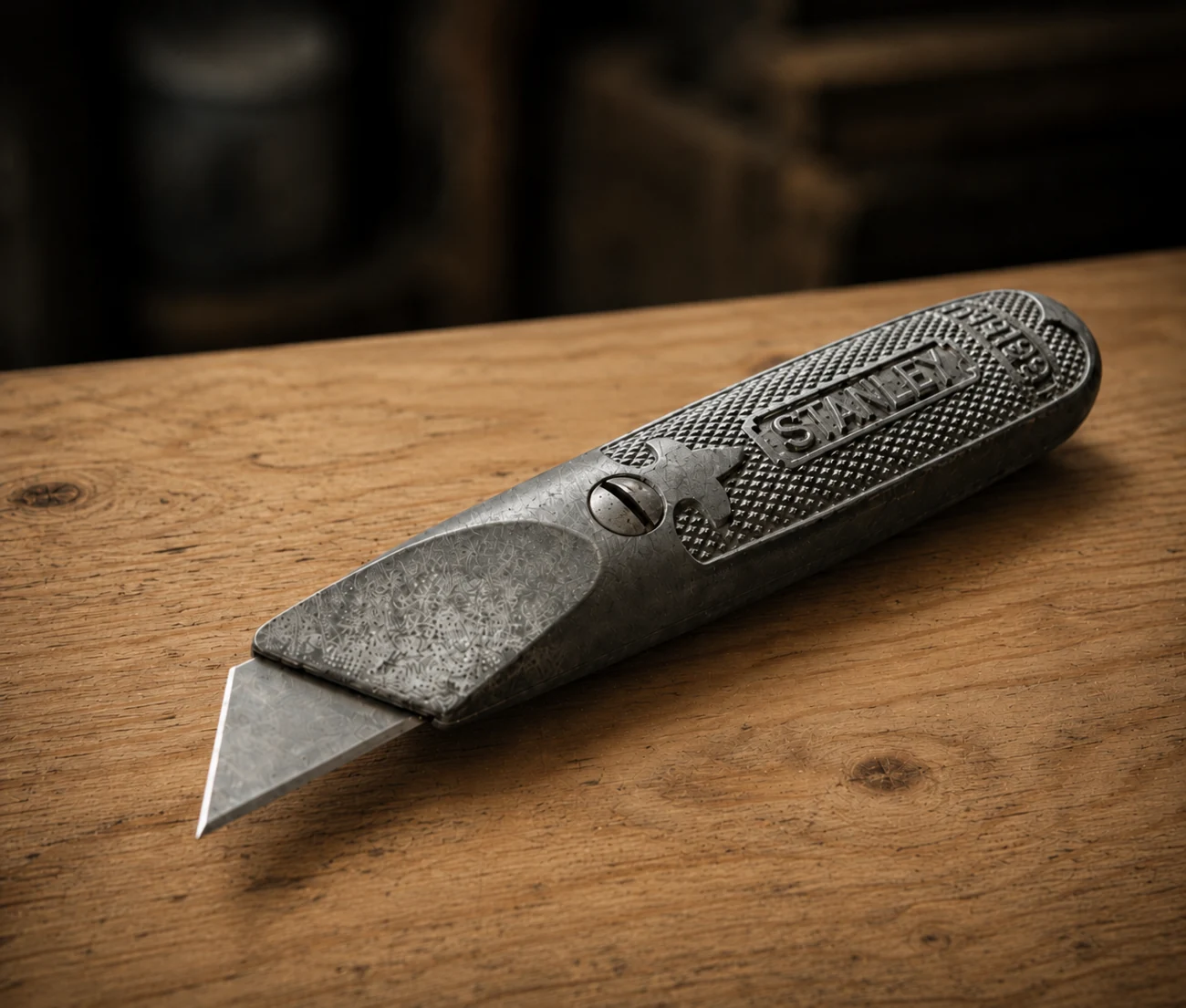
Then I lost my Stanley No. 199 utility knife.
Replacing a utility knife should be one of the simpler transactions available to an adult human. They are inexpensive, widely available, and almost aggressively ordinary. Nobody expects to pass one down to a grandchild accompanied by a story about the winter of 1987.
I went to buy another one. Instead I found the wall.
There were utility knives with rubber grips and utility knives with folding bodies. There were quick-change mechanisms, blade magazines, safety locks, sculpted handles, clips, hinges, buttons. Every version seemed to be engaged in a desperate effort to become the best utility knife ever invented.
I stood there, annoyed, because none of the features were obviously stupid.
Changing a blade without a screwdriver was convenient. A safety lock was safer. A folding body was compact. One by one, every decision made sense.
I eventually bought a DeWalt, not because it was the knife I wanted but because at some point one has to stop conducting an epistemological inquiry in the tool aisle and get back to work. Plus it looked super cool.
In several small ways, the DeWalt was better than the Stanley. It was lighter. It folded. It had a clip that kept the knife exactly where I needed it.
The clip, unfortunately, also occupied the same territory as the back of my hand. When I walked, I would occasionally smack my hand against it. There was nothing wrong with the clip. The clip was doing precisely what it had been designed to do.
The folding body presented the same sort of problem. Folding made the knife compact, which required a pivot. The pivot introduced the slightest flex under pressure, not enough to make the knife bad, but enough that I noticed the loss of control I'd taken for granted with the Stanley.
The DeWalt’s improvements were real, but so were their consequences.
A few days later I ordered another Stanley No. 199.
It arrived: a hunk of metal on a cardboard backing held in place by a thin layer of formed plastic, perhaps the least theatrical consumer experience still available in modern retail. I unclipped the DeWalt from my pocket and slit the packaging.
Back in the studio, I installed a fresh blade and started cutting a piece of four-ounce leather.
There was no flex.
The handle disappeared into my hand.
The DeWalt had never been unpleasant to use. It had simply never stopped announcing itself. The clip reminded me it was there. The pivot asked for tiny corrections under pressure.
The Stanley asked nothing of me. I really looked at it.
Two cast-metal halves. A screw. A blade.
That's it.
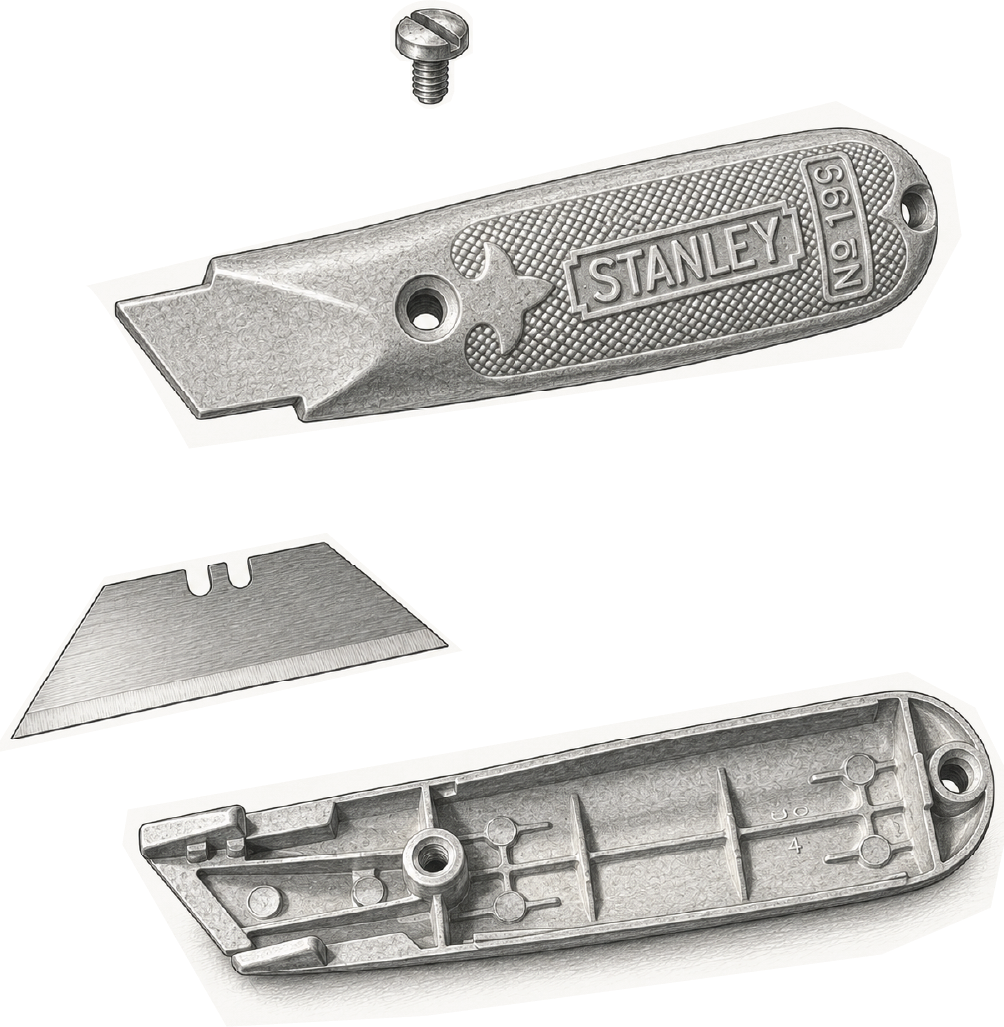
The handle is rounded and tapered because that's what fits the hand. The blade is fixed because rigidity gives control. Spare blades live inside the handle. When one edge dulls, you loosen the screw, turn the blade around, and keep working.
Nothing broadcasts the intelligence that produced it. It doesn't ask to be admired; it asks to be used. I'd carried one for twenty years. It was the first time I'd really seen it.
By almost any individual measure, the newer knives were better. They were safer. Lighter. More versatile. They solved problems the Stanley did not.
So why didn't I want the better knife?
The wall bothered me because every knife on it was the result of decisions that were difficult to argue with. There was no single feature you could point to and say: There. That's where they ruined it.
That was when Joe's “compliment” came back to me. Every decision I'd made while building the desk had been in pursuit of something I genuinely valued. A beefier top was stronger. A gusseted leg was stronger. A lap joint was stronger.
At no point had I made an obviously foolish decision. Strength had started as one quality of a good desk. Somewhere along the way, without my noticing, it had become the quality. And once that happened, every decision that made the desk stronger also appeared to make the desk better.
I wasn't asking whether I was making a good desk anymore. I was asking whether I could make it stronger. And because I could, I did.
The Stanley had done something different. It wasn't good because it was old. Plenty of old things are terrible. And it wasn't good because it was simple. Simplicity by itself is no virtue either. A rock is simple. What struck me was that no single decision in the Stanley had been allowed to become the point.
Somewhere in the development of that little gray tool, someone (or a long succession of someones) had reached the place where making one part better would make the whole thing worse.
And somehow they had stopped.
Joe hadn't been telling me the desk was badly made. He was telling me the opposite. It was extremely well made, strong enough, in fact, to hide under during an earthquake...
I had heard the compliment and missed the question.
How strong can a desk be?
How strong does a desk need to be?
They are separated by only a few words. I had answered the first question very well. It had never occurred to me to ask the second.
Joe had seen the bunker.
I had seen only the good decisions that made it.