
McMasters of the Universe
In appreciation of a big yellow book
In certain design offices and machine shops of yore, the possession of a truly enormous supply catalog published by a company called McMaster-Carr was a reasonably reliable indication that you were somebody who knew how to get things done.
McMaster-Carr, for the uninitiated, is an industrial supply company specializing in the distribution of an almost inconceivable variety of mechanical components, fasteners, and other things whose existence the average person has no occasion to contemplate.
This makes it, to a certain kind of person, one of the most wonderful organizations in the world.
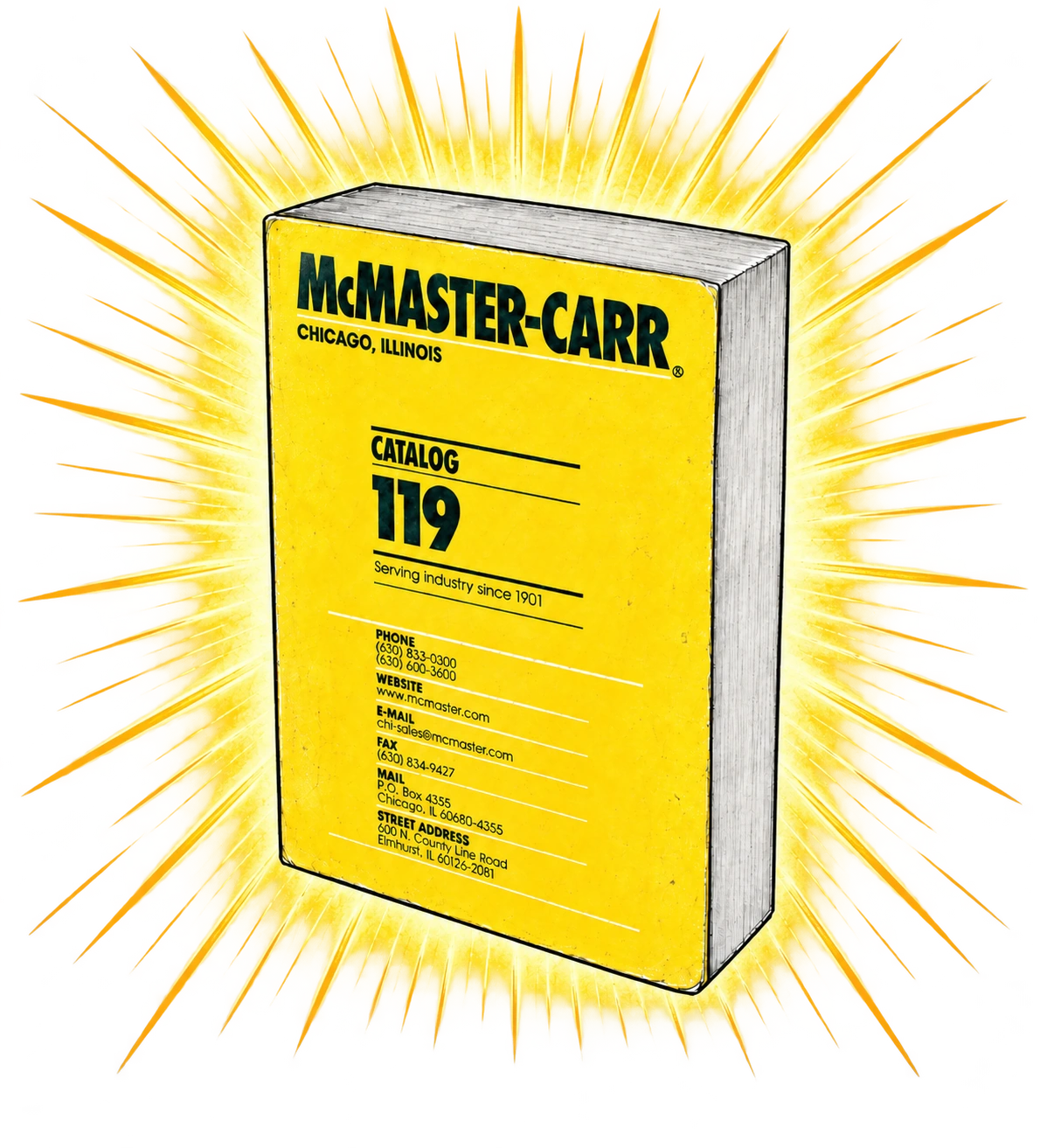
Suppose you're designing something and need a particular type of fastening mechanism. You consult the index, which requires equal parts patience, deductive reasoning, and a willingness to admit that the thing you are looking for may have a perfectly legitimate name of which you are entirely ignorant.
Eventually you find a promising category and begin turning pages. What happens next is difficult to explain to someone who has never experienced genuine excitement at the discovery of an unfamiliar hinge.
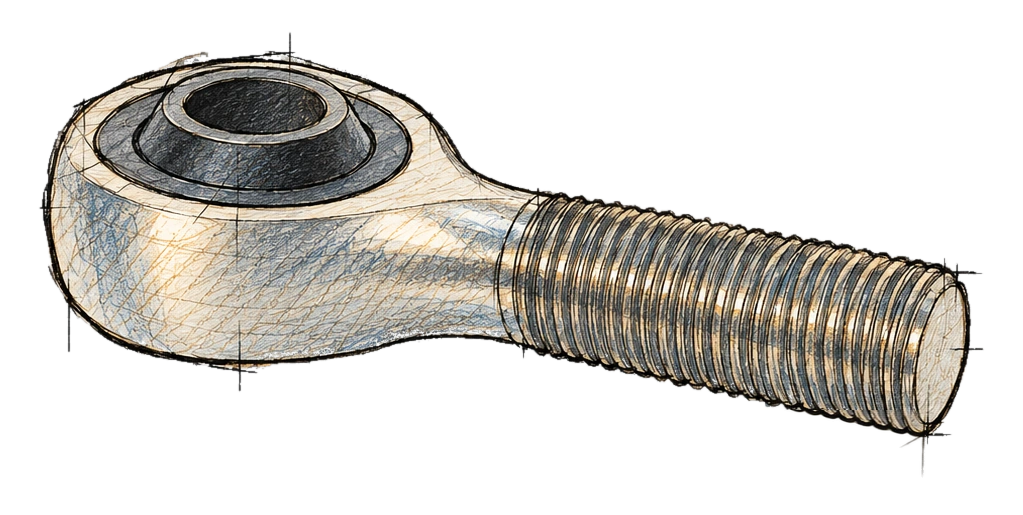
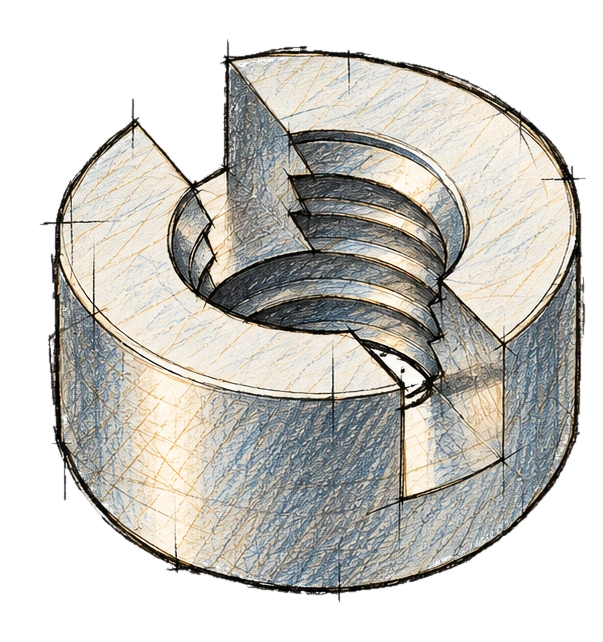
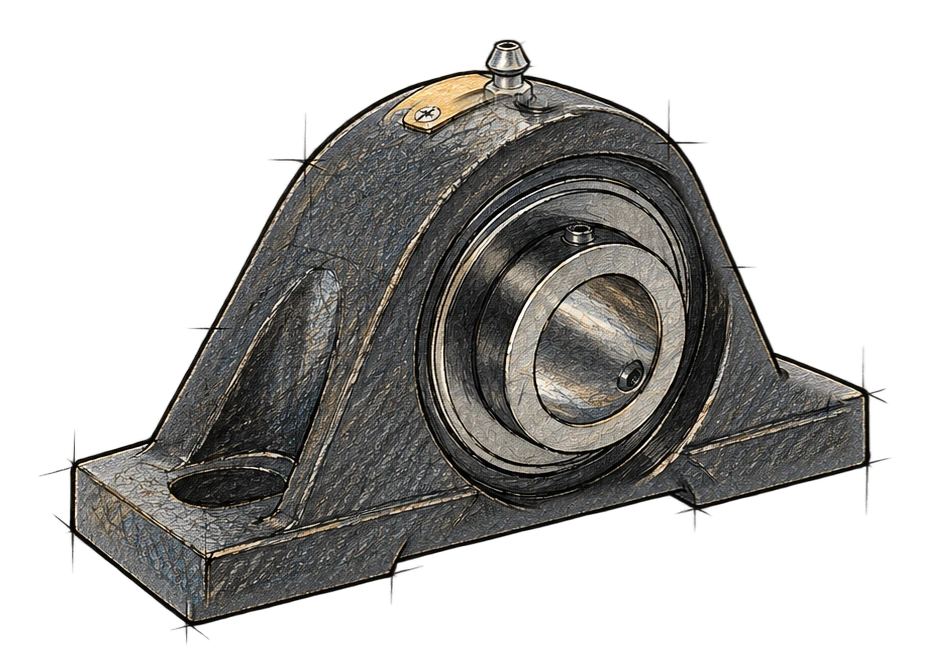
There are fasteners you didn't know existed. Oddly specialized bearings, springs, and mechanical contrivances whose ingenuity is immediately apparent even when their intended application isn't. You begin to recognize possibilities that hadn't occurred to you five minutes earlier, but you also start creating solutions to problems you don't actually have.
At some point you've forgotten what you were originally looking for. This is how an afternoon can disappear into an industrial supply catalog.
The catalog was also a remarkably effective textbook. A sort of Encyclopedia Mechanica, except you could order the illustrations.
Then, of course, everything went digital.
I say of course because this is normally the point in a narrative where the author begins lamenting the disappearance of a superior analog culture and the corresponding decline of civilization.
Unfortunately for those inclined toward nostalgia, McMaster-Carr made an exceptionally good website.
So there.
The website retained the catalog's organization while making it possible to navigate with an efficiency the physical book couldn't provide.
Specifications became filters. Categories became searchable. Dimensions could be compared without balancing an open catalog on an already overcrowded table and risking your coffee.
And then came downloadable CAD models.
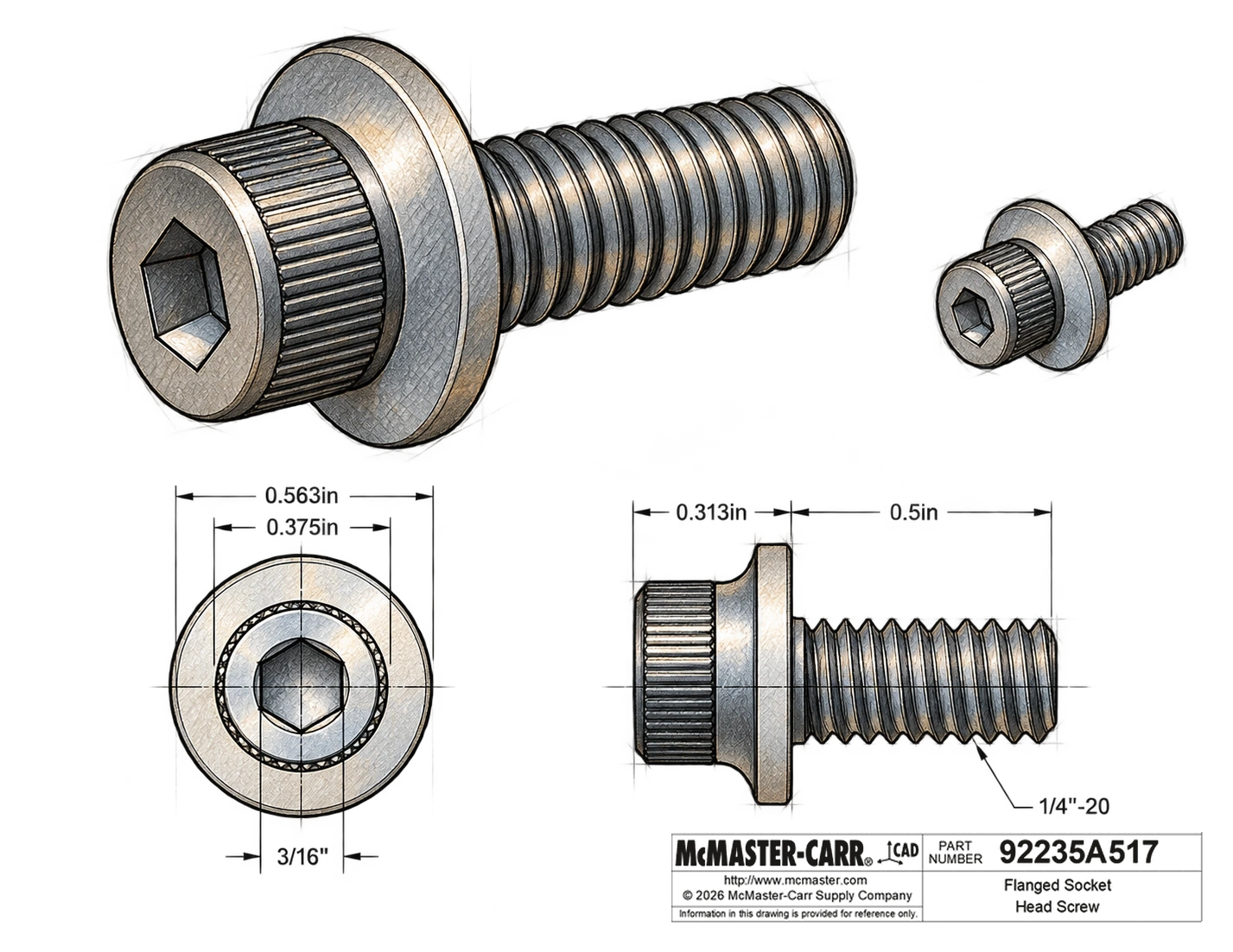
This eliminated a peculiarly joyless task: modeling a component someone else had already designed, simply to show where it belonged in our own work.
I understand that the ability to download a three-dimensional model of a shoulder bolt is not something most people would identify as a major advance in the human condition. But I would suggest that most people have never needed to model a shoulder bolt.
I still love the physical catalog. I love its unreasonable size, its density, and the almost archaeological experience of discovering an unfamiliar bushing.
But I don't particularly want to go back to ordering from it. The website is faster. The information is easier to retrieve. The CAD models are invaluable.
I don't miss ordering from the book. I miss getting lost in it.
Which brings me to the reason for this rather elaborate valentine to a company that sells nuts, bolts, and industrial adhesives.
Making things is, in large part, an exercise in recognizing possibilities. Experience helps, certainly, but experience is partly a matter of knowing what exists and where to look for it.
McMaster-Carr has spent a very long time making that last part easier.
I can't think of another supplier that has contributed more to my ability to turn ideas into physical objects. That's a peculiar thing to say about a distributor of industrial hardware, and I concede that the sentiment may be difficult to explain to anyone who has never experienced the quiet exhilaration of finding precisely the right component for a problem that had seemed intractable.
Occasionally, the most useful thing anyone can do for a maker is simply to show them what's possible.
Preferably with dimensions.
And a part number.