
Spoon
A spoon is not a fork, the same way that a shovel is not a hammer.
The common spoon.
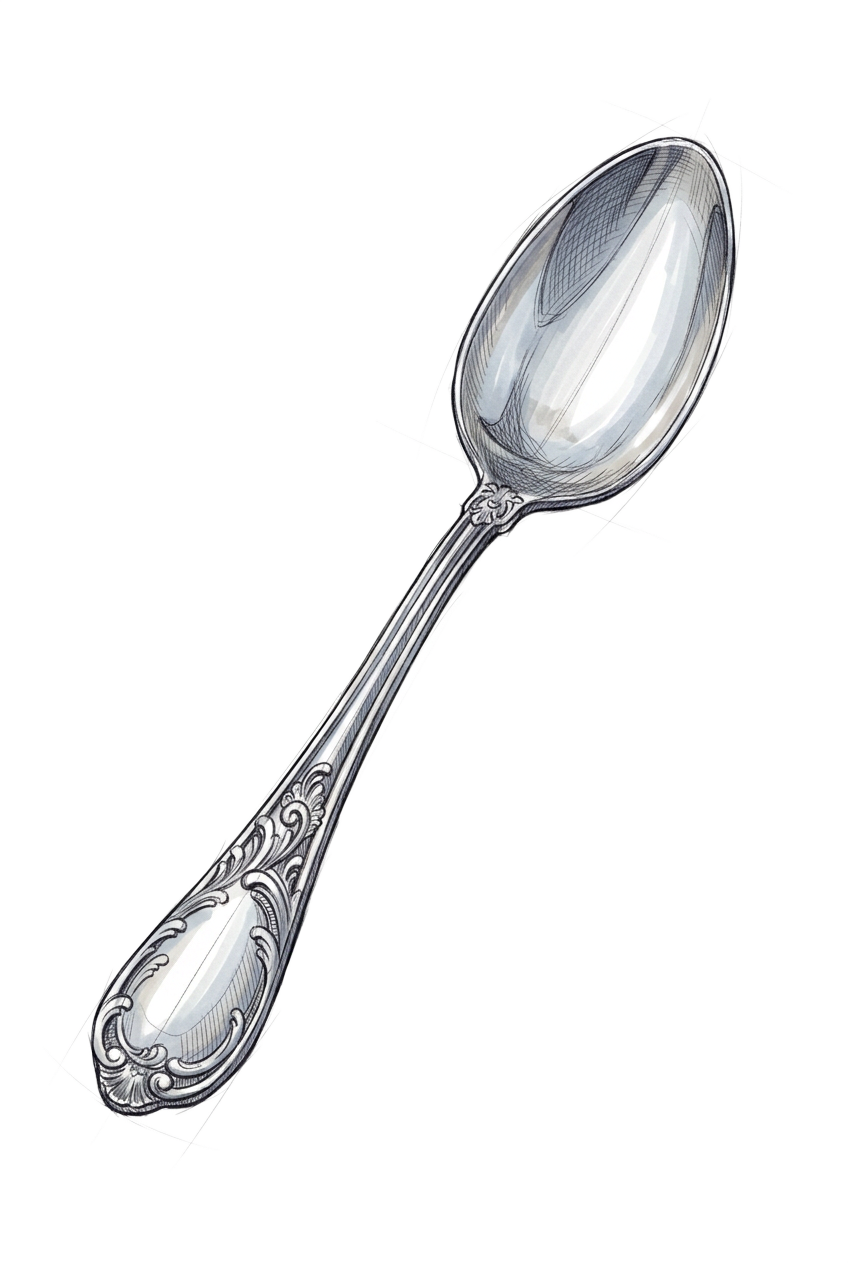
This is the base model. The free trial before paying a monthly fee. It is ubiquitous, simple, and about as utilitarian as you can get.
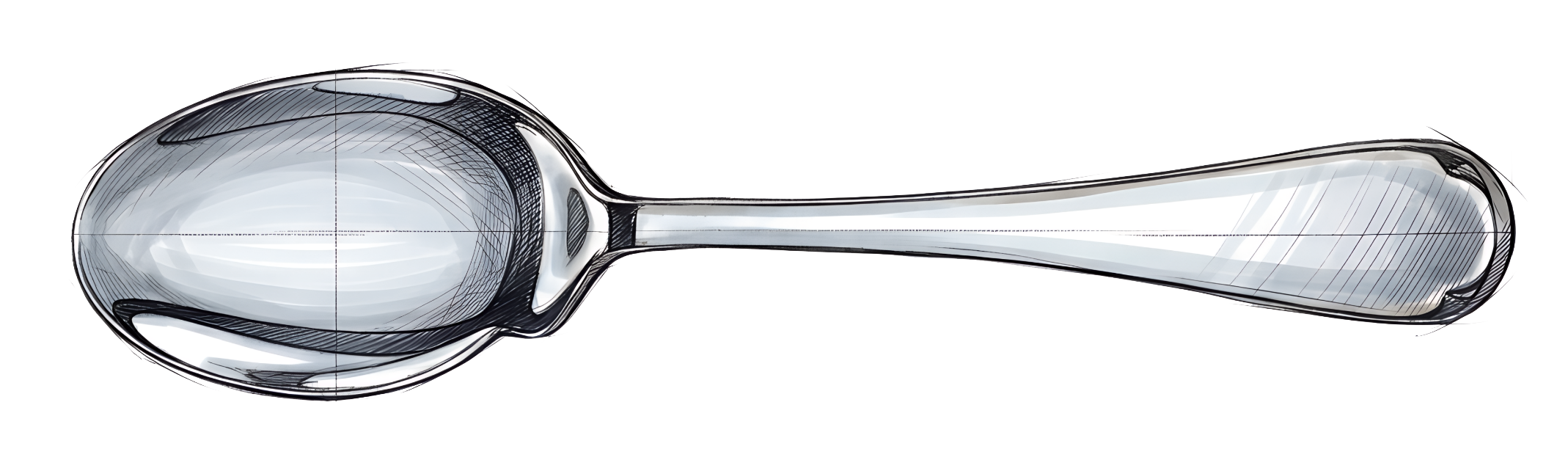
Its premise is seemingly simple: a shallow concavity with a handle, used to hold something until you can get it to your mouth hole. Yet that seems to be an inherently difficult thing to accomplish. Consider its anatomy. The bowl. The tip, the rim, the heel. The stem, the neck, the throat, the shoulder, the bend. The handle. The butt. And finally, the knop.
All this to get soup into your face.
For something so ordinary and commonplace, the common spoon is surprisingly easy to get wrong.
Years ago we purchased a dinnerware set. I’m not sure if we inadvertently purchased a door to another dimension as an add-on, but I estimate that 60% of our current spoons don’t match the original set. I had this pet theory that the lady who comes every two weeks to clean our house had some diabolical hobby of slowly switching out the spoons between the houses she cleaned as a form of recreational sadism, but I eventually abandoned the notion as some sort of John Cheever plot and therefore, unlikely.
Of that 60% of mismatched spoons, there is one that hits all the right notes. The bowl is the perfect size, neither too big nor too small. It has just a little extra weight that makes it feel substantial without upsetting its balance. And the design is restrained but interesting. It has caused a secret war to be waged in our household. You see, both my wife and I covet that spoon. It hasn’t come to one of us hiding it from the other yet. Though I will admit that it has crossed my mind.
So let's set the table (haha!). Spoon design has not laid down its burdens and taken a nap. Oh no. Spoon Design has been BUSY.
The Prendispaghetti
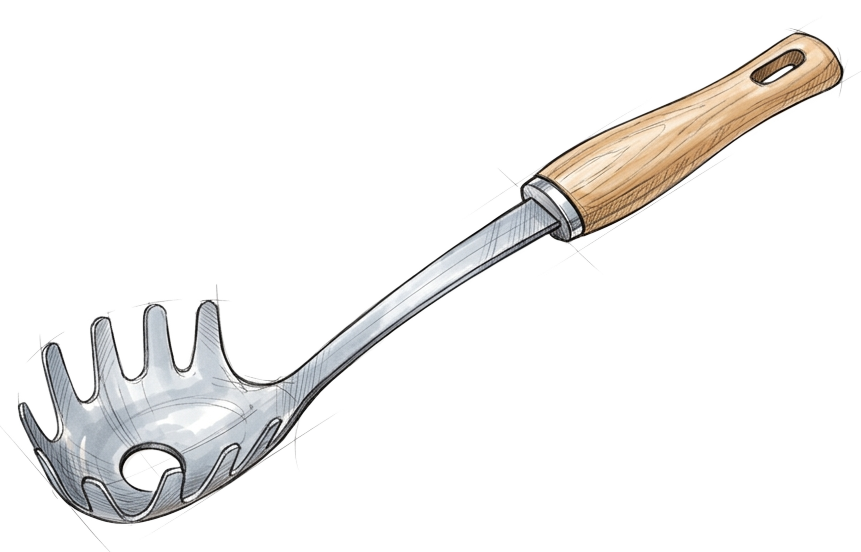
Part facehugger, part ingenious contraption. Consider its proportions and features: a concavity connected to a handle (which passes my spoon taxonomy with flying colors!).
And to the half of the room that would readily point out that there is a hole in the middle of it, I have two words for you: slotted spoon.
Everything you need to know about the prendispaghetti is in the name. Prendi meaning to pick up. Spaghetti meaning spaghetti.
In all seriousness, the design really has a lot going for it. Using a regular spoon to liberate long, skinny noodles from a pot is kind of like trying to pick up a ping-pong ball with a chopstick. But the prendispaghetti’s facehugger tines, in concert with the spoon body, make the activity magic. One scoop or two, Grandpa?
“Non fare il tirchio!”
And that hole in the middle that was making half of you itchy? It’s used to measure one portion of dried spaghetti. BOOM!
But let us now switch gears, stow our irreverence and travel to the land of the rising sun.
The Renge
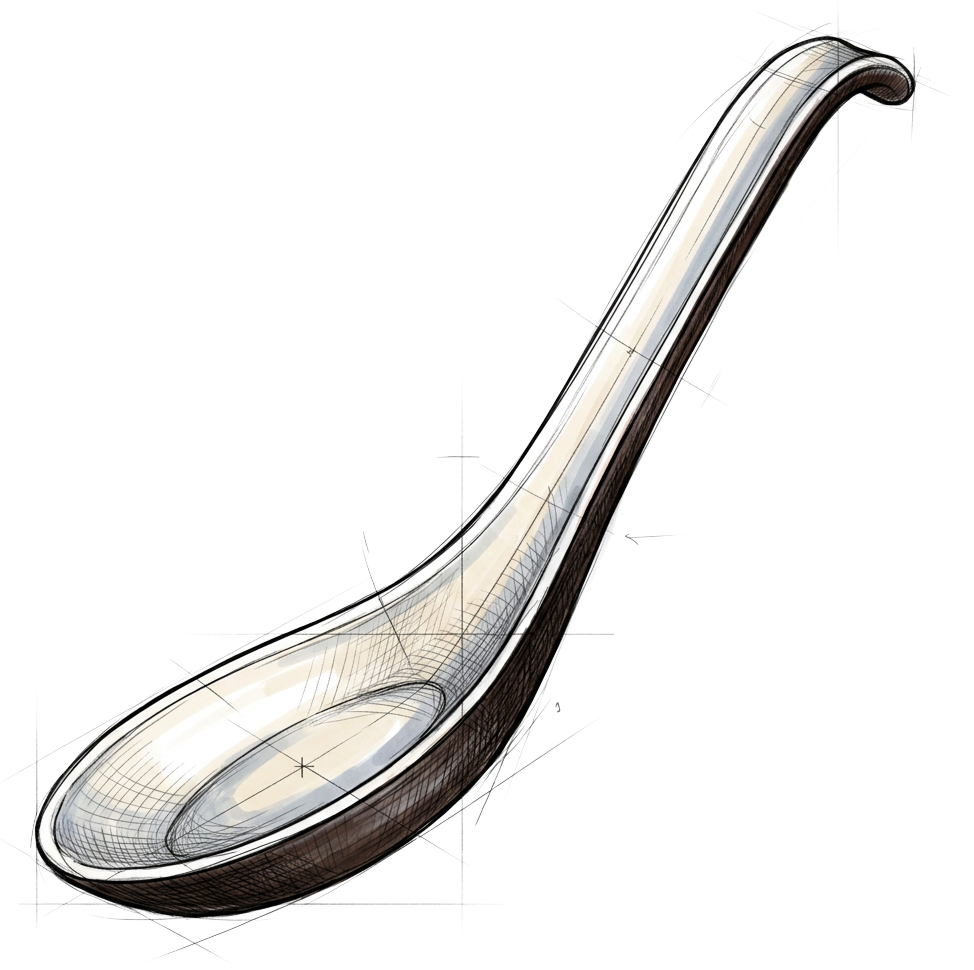
This is a spoon from mythological times. I wasn’t able to find any evidence that dragons were involved, but I refuse to dismiss the possibility. The renge is supposed (I looked it up on Wikipedia) to have originated around 200 BCE in China and was originally used for congee. The form I am concentrating on is the more modern Japanese version used for ramen and udon. Some might say it has more in common with a ladle, but those people generally think Van Halen was better with Sammy Hagar.
It has a flat bottom, which means you can scoop up a nice spoonful of broth and set it down on the table, contemplate the droplets of fat glistening like tiny jewels as they catch the light, then pick it up again and toss it back into your mouth hole. Many versions have a hook at the end, so if you’re not into the whole Zen contemplation thing and need to take a break, you can hang the end of the renge on the rim of your donburi and contemplate why you were dumb enough to bet on the Patriots.
Which brings us, unerringly, to France. Well, not really France, but another weird-ass variation on our chosen subject.
La cuillère à sauce
I almost missed this one. At first glance it looks like an ordinary spoon. Deux secondes! What is that strange little asymmetrical flare on one side? Why, sacrebleu! It's a notch, apparently intended to drain excess oil when scooping up sauce. And on the other side, a thin edge for scraping up the last of the sauce from your plate, just like a squeegee. What will they think of next?
To be fair, I have no idea if either feature actually works, but let me know in the nonexistent comments.
Okay. Real talk? This one seems a little ridiculous, even to me. Did anyone actually ask for this? Were beret-wearing malcontents banging on the door of some French spoon designer (a cuillériste, by the by), demanding that someone finally do something about the oil in their sauce?
There’s a scenario playing out in my head. Somewhere in France during La Belle Époque, l’ingénieur de la cuillère looked at a perfectly fine soup spoon and thought, Non. We can do better.
He then spent the next thirteen years perfecting la cuillère à sauce, while his filthy, shoeless children lay listless on the floor and the gendarmes pounded on the door, waiting to drag him off to debtor’s prison. Whoa dude, that got real dark, real fast.
The Loving Spoonful
The world is full of specialized spoons. Some so specialized that they challenge the definition of spoon. There are spoons for bonbons (three types, actually), absinthe (cuillère à absinthe), cocaine, and marrow (technically a scoop, but hey). There’s even one for keeping your mustache out of your pudding.
And yet, I keep coming back to the common spoon. Unassuming, earnestly useful, and surprisingly easy to get wrong. But when someone gets it right, it’s a thing to treasure.
Which reminds me. I need to hide something.